
21
Sep 2026
Choosing a school is one of the most important decisions parents make for their child. When considering a Cambridge
school in Mumbai, it is easy to focus on infrastructure, facilities or a school’s reputation. But there is more to
evaluating an international curriculum.
Parents should also look at the Cambridge pathway offered, subject choices, teaching approach, global
exposure and university guidance. These factors can influence how well a school supports a child from
the early years through senior secondary education and beyond.
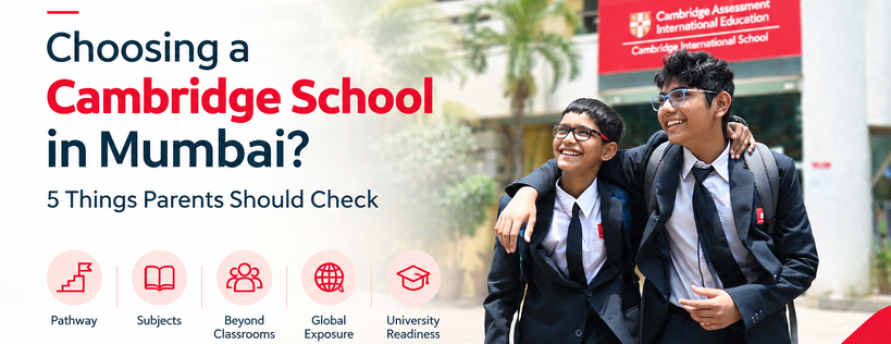
Here is a practical five-point checklist to help parents evaluate a Cambridge school in Mumbai.
One of the first questions parents should ask is: How far does the Cambridge pathway continue within the same
school?
A continuous academic journey can help students avoid unnecessary curriculum changes or school transitions as they
progress through different stages of education.
Parents can check whether a school offers a progression covering:
A school offering multiple stages of the Cambridge pathway can provide greater continuity, while also allowing
students to become familiar with the curriculum and its learning approach over time.
At MET Rishikul Vidyalaya (MRV), Bandra, the Cambridge journey
begins with Cambridge Early Years at the Pre-Primary level and continues through Cambridge Primary,
Secondary, IGCSE and AS & A Levels.
This creates a pathway from the early years to senior secondary education within one Cambridge-focused environment.
Another important consideration is how much choice students have as they move into higher
grades.
The Cambridge curriculum offers students opportunities to explore different academic disciplines. At the IGCSE and
AS
& A Level stages, subject selection becomes particularly important because students may begin aligning their
studies with their interests, strengths and future university plans.
Instead of simply asking, "Which subjects does the school offer?", parents can ask:
At MRV, the emphasis on "Power to Choose" supports the idea that students should have room to shape
their academic journey according to their interests and aspirations.
This flexibility can be particularly useful for students who may not have finalised their university or career
direction while choosing their IGCSE and A Level subjects.
A Cambridge education is not limited to textbooks and examinations. Parents should understand how a school translates
the curriculum into everyday learning.
Ask about opportunities for:
The objective is to understand whether students are given opportunities to apply what they learn,
rather than simply prepare for assessments.
At MRV, academic learning is complemented by a range of co-curricular and enrichment opportunities. Students can
participate in activities and programmes that encourage communication, leadership, creativity and global awareness.
For many families choosing a Cambridge school, international exposure is an important consideration.
However, global exposure does not necessarily mean travelling abroad. Students can develop a global perspective
through programmes, collaborations, competitions and activities that introduce them to different cultures, ideas and
viewpoints.
Parents can look for opportunities such as:
MRV's enrichment ecosystem includes programmes such as Model United Nations (MUN) and the
International Award for Young People (IAYP), giving students opportunities to develop qualities
beyond academic performance.
These experiences can help students build communication, collaboration, leadership and organisational skills that
are
relevant both within school and beyond it.
The final stage of school education is closely connected to what comes next. Therefore, parents should also ask how a
school supports students with higher education planning.
University guidance can include:
This becomes especially relevant for students pursuing AS & A Levels, as their subject combinations and academic performance can play an important role in their undergraduate applications.
When parents use these five factors to evaluate a Cambridge school in Mumbai, MET Rishikul Vidyalaya (MRV),
Bandra offers a combination of academic continuity, subject flexibility, enrichment and higher
education guidance.
Its Cambridge pathway begins with Cambridge Early Years at the Pre-Primary level and progresses
through Cambridge Primary, Secondary, IGCSE and AS & A Levels. Students also have opportunities to explore
different subjects and participate in programmes designed to develop global awareness, leadership and wider
skills.
For parents, this makes the evaluation process more concrete: rather than looking at a school only through
infrastructure or academic results, they can consider the complete educational journey the school
provides.
Before making a decision, consider asking these five questions:
The answers can help parents compare schools based on what matters for their child's long-term educational journey.
Choosing a school is ultimately a decision best made with a clear understanding of the environment, curriculum and
opportunities available to students.
Parents considering a Cambridge school in Mumbai can visit MET Rishikul Vidyalaya,
Bandra, to understand its Cambridge pathway, explore subject options, experience the campus and learn
more about its academic and co-curricular offerings.
Book a campus tour to explore the learning environment, subject options, and facilities in
person.
 Leave a reply
 Reviews (0)


©Mumbai Educational Trust, All rights reserved | Last Modified Date: Friday, September 27th, 2019